
The Look Back
On Love, Doubt, and the Unbearable Weight of Almost

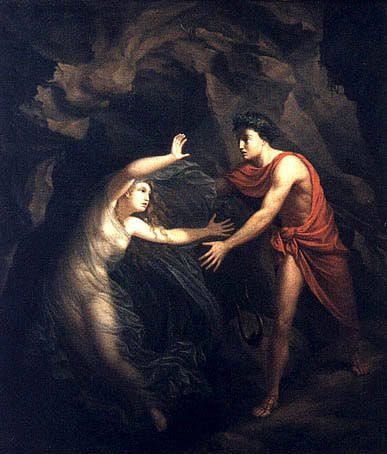
(Inspired by the myth of Orpheus and Eurydice)
There is a story so old it has forgotten it is a story. It lives now in the body — in the chest, specifically, in that particular contraction that happens when you love someone and fear, all at once, that love itself is the most fragile thing you have ever been asked to carry. It is the story of a man who walked into the kingdom of the dead for love, who moved stone and shadow and the cold machinery of the underworld with nothing but a lyre and the unbearable sincerity of his longing — and then, at the last possible moment, with the light of the living world already gold on his face, turned around and lost everything.
We call it a tragedy. We shake our heads. We say: he should not have looked. But I wonder if we have been reading it wrong all this time. I wonder if the look back is not the failure of the story but its most profound and human truth — the moment where Orpheus stops being a myth and becomes, instead, a mirror.
Let us begin at the beginning, which is always, in love stories, not quite the beginning.
Orpheus was the son of Apollo and the muse Calliope, which is to say he was born into the intersection of music and memory — two things that have, in every civilization that has ever existed, served as love’s most faithful companions. He played the lyre with such devastating beauty that rivers paused in their beds to listen. Trees uprooted themselves and walked toward the sound. The rocks, which have no ears and no hearts and no reason to care about anything, wept. This is what we mean when we say someone is gifted: not that they are merely skilled, but that the world reorganizes itself slightly in response to their making.
And then he met Eurydice, and the music changed.
This is the detail the myth skips over too quickly, the way all myths skip over the interior life in favor of the event. We are told they married. We are told she died — a serpent in the grass, a wedding day interrupted by the most permanent kind of departure. We are not told, in enough detail, what it felt like to be Orpheus in the days between her death and his decision to descend. But we can imagine it, because the myth is old enough to have soaked into our collective understanding of what love costs. He would have continued breathing. He would have eaten, probably, and slept, in the way that the body insists on its own continuation even when the mind cannot find a single reason to cooperate. He would have played the lyre, and for the first time in his life, the music would have sounded wrong to him — not because his skill had diminished, but because the person who had changed what the music was for was no longer there to hear it.
This is the first thing the myth teaches us about love: that love is not merely an emotion directed at a person, but a reorganization of meaning. When Eurydice died, it was not only Eurydice that Orpheus lost. He lost the entire interpretive framework she had given him — the reason the music mattered, the reason the morning was worth beginning, the particular quality of attention that had made him feel, for the first time perhaps, genuinely received by the world. Grief at this depth is not simply missing someone. It is the sudden illegibility of everything you thought you understood. The self that loved her does not know how to continue in a world where she is not.
And so he went after her. Of course he did. What else was there to do?
The descent into the underworld is, philosophically speaking, love’s most radical gesture. To descend is to refuse the terms the world has set. To descend is to say: I do not accept this. I do not accept the boundary between the living and the dead, between presence and absence, between the life we had and the nothing you are offering me in its place. Every great love story contains some version of this descent — some moment where one person refuses the rational course, the safe course, the course that any sensible observer would recommend, and instead walks straight into the dark because the alternative is a life organized around an absence they cannot learn to call enough.
What Orpheus carried with him into Hades was not a weapon. It was a lyre. This distinction matters enormously. He did not go to conquer death or argue with it or overpower it through force or cunning. He went to move it — which is a different thing entirely, a thing that only love at its most pure and most desperate attempts. He played for Persephone and Hades, and the music was so saturated with longing, so honest in its grief, that even the dead stopped wandering to listen. Even the Furies — those ancient, implacable engines of punishment — wept. The myth tells us that Sisyphus sat down on his boulder and rested for the first time in eternity. The wheel of Ixion slowed. The stone remembered what it was to be still.
This is what love, expressed without armor or performance or the usual self-protective ironies, actually does to the world. It stops things. It creates, in the midst of all that relentless forward motion, a moment of pure arrested attention. When Orpheus played, the underworld had to stop and feel something, because the music was not asking for anything except to be heard in its full weight of truth — and the truth it carried was this: I love her. I love her so specifically and so completely that I have walked into death to say so, and I would walk further still, if further were a direction that existed.
Hades relented. Because even death, it turns out, recognizes something in love that cannot be refused.
And here is where the story gathers its full philosophical weight, where it stops being a legend and becomes instead a question addressed directly to the reader, to anyone who has ever loved someone and felt, beneath the loving, the cold subterranean current of doubt.
The condition is simple. Walk back to the living world. Walk up through the dark passageways of the underworld, through the layers of stone and silence and accumulated human grief, back toward the light. And do not look back. Eurydice will follow. Trust that she is there. Trust the rustle you cannot hear. Trust the footstep you cannot confirm. Trust, simply, that love — even love tested by death, even love bureaucratically granted by the king of the underworld — is real enough to follow you home.
Do not look back.
And Orpheus almost makes it. This is the detail that is almost too painful to hold. He is almost there. He can see the light. He can feel the air beginning to change, can feel the warmth of the living world on his face after the cold grey endlessness of the kingdom of the dead. He has done the impossible thing. He walked into death and the music was enough and Hades said yes and all that remains is this one corridor, this one final passage, and then the sun and the world and her hand in his and the rest of their lives together —
He looks back.
Why?
This is the question on which centuries of philosophers, poets, artists, and ordinary heartbroken people have snagged themselves. Why does he look? The myth offers no interiority at this moment, which is both its great frustration and its great wisdom — because by refusing to explain, it forces us to supply our own answer from our own experience, and our own experience is where the myth was always pointing.
Some say he doubted Hades. That he could not believe the gift was real, that some part of him suspected the silence behind him was empty, that he had been tricked by hope into believing something the world has taught us is never actually given. This reading is about faith — about the difficulty of trusting what you cannot see or hear or confirm, about the way trauma and loss can corrode our capacity for simple belief until even the most extraordinary grace feels too fragile to hold without checking.
But I think there is another reading, darker and more interesting, which is this: I think Orpheus looked back because he doubted himself.
Not Hades. Not the terms of the agreement. Not even Eurydice. Himself.
Because this is what love’s deepest fear actually is — not that the beloved will fail us, but that we will fail them. Not that we are unloved, but that we are somehow, in some essential way that we cannot quite articulate and cannot quite disprove, not enough to deserve the love that has been given. That the whole impossible journey — the lyre, the weeping Furies, the mercy of Hades, the gift of her following footstep — is somehow more than what we are actually worth. That it will be taken back. That we will arrive at the threshold of everything we wanted and discover, at the last possible moment, that it was never really meant for us.
Self-doubt in love is not the fear of loving badly. It is the fear of being fundamentally, cosmically insufficient to be loved well. And it is the quietest, most persistent, most ruinous of all love’s complications — quieter than jealousy, more tenacious than grief, more devastating than rejection because it comes entirely from within. No one has told Orpheus he is not enough. Every instrument of the underworld has confirmed that he is extraordinary. And still, at the threshold, the doubt speaks louder than all of it. The doubt says: are you sure? Are you really sure she’s there? Are you sure you deserve this? Are you sure you haven’t imagined the whole thing?
And he turns. And she is gone.
There is a particular philosophical cruelty in the structure of this myth that I think we do not examine enough: the fact that his looking back is also an act of love. It is not selfishness that turns him around. It is not impatience or distrust of Eurydice specifically. It is the overwhelming, unbearable tenderness of someone who loves so much that he cannot stop himself from needing to confirm that the love is real, that she is real, that he has not dreamed her into being and will arrive at the surface to find himself alone again. The look is grief translated into gesture. The look is three months of loss trying to reassure itself in the only way it knows how — through the eyes, through seeing, through the most direct and human of all our confirmations.
And the tragedy is that love, in this instance, cannot accommodate the confirmation. It requires — demands — a faith that has no proof, a trust that cannot check its own receipts. It requires you to walk forward in the dark believing that what you love is behind you, close enough to touch, following you home — and to resist every human impulse to make sure. To keep going without looking. To take the final steps toward the light bearing nothing but the hope that hope is enough.
This is, I would argue, the most accurate description of love’s daily requirement that mythology has ever produced. Not the grand descent. Not the music that moves the dead. The corridor. The dark walk upward. The choosing, again and again with every step, to trust rather than confirm, to believe rather than verify, to keep moving forward without the reassurance that what you love is still following.
Love at its most demanding does not ask you to perform heroic gestures in the kingdom of the dead. It asks you, quietly, on an ordinary day, to keep walking without looking back. To trust the footstep you cannot hear. To believe in the presence you cannot see. To carry the relationship forward into the light on nothing more than the faith that it is real and that you are worthy of its being real and that the universe, having arranged this particular love for you, intends for you to arrive at the surface together.
And yet. And yet I want to say something in defense of Orpheus that the myth does not say, because the myth is old and myths were not always kind to the people trapped inside them.
His looking back is not a moral failure. It is a human one, which is entirely different. The distance between moral failure and human failure is the distance between condemnation and compassion, and Orpheus deserves the latter. He was a man who had already lost her once. He was a man who had spent however long it takes to make the descent and play for Hades and negotiate the impossible carrying the accumulated weight of that loss in his body. He was a man who had never, in all the legends about him, been described as someone who trusted easily — only as someone who felt deeply. And at the last possible moment, the feeling overcame the faith. Not because he was weak. Because he was human, and humans, even the most gifted and most loving of them, have a limit to what they can hold in sustained uncertainty without needing to look.
The real lesson of Orpheus is not don’t look back. The real lesson, the one that lives underneath the myth and breathes there quietly for anyone patient enough to find it, is this: love requires a faith in yourself that is as strong as your faith in the beloved. It requires you to believe not only that they are following, but that you deserve to be followed. That the music was real and the mercy was real and you are, in fact, the kind of person toward whom love walks willingly through the dark.
Orpheus could not quite believe that last part. And in that failure of self-belief, he lost her. Not because the universe is unjust, but because love — which is the most interior of all experiences — cannot ultimately be more certain than the person at its center is certain of themselves.
We are all, in some form, Orpheus. We have all loved someone with a completeness that surprised us, have all discovered in ourselves a depth of feeling we did not know we were capable of, have all stood at some threshold asking ourselves whether we deserve the extraordinary thing that seems to be following us toward the light. Some of us look back. Some of us — through discipline or grace or simple exhaustion at the alternative — manage not to.
But what the myth gives us, finally, is not a moral instruction. It gives us permission to understand the looking back as love — imperfect, frightened, human love, the only kind that actually exists among people who have been hurt before and hope anyway. Orpheus did not fail to love Eurydice. He loved her so completely that the love became indistinguishable from fear, and in that place where love and fear converge, he did the most human thing: he reached, one last time, for the certainty that only presence can give.
She was there. Right there, just behind him, close enough that the air between them was still warm with the fact of her.
And then she wasn’t.
And the music he made after — the music he made in the long, shattered years that followed, wandering the hills of Thrace, refusing every comfort, playing into the indifferent rivers — that music, they say, was the most beautiful he ever made. Because it carried everything now: the love, the loss, the almost, the corridor, the moment of turning, and the unbearable knowledge that he had held the most extraordinary thing, and that he had looked, and that looking had been enough to end it.
That music is still playing, somewhere. It is in every poem ever written about longing. It is in every love song that knows it is a grief song in disguise. It is in the space between what we feel and what we can allow ourselves to believe we deserve to feel.
It is, perhaps, in whatever brought you to this essay on this particular day.
And it is beautiful. It is so, unbearably, beautifully beautiful.
Even from here.
Hello, My Dear: Welcome back, I missed you. "Love requires a faith in yourself that is as strong as your faith in the beloved" is one of the most powerful statements ever written. I am my own victim of self-doubt and have paid the price. Thank you for sharing the story of Orpheus.
This was a fascinating rereading of a myth I thought I already knew. What stayed with me most was not your conclusion, but the question itself: why do we look back? I appreciated how you moved beyond the traditional interpretation and explored the possibility that Orpheus wasn't failing Eurydice as much as struggling to trust himself. Whether one agrees with that reading or not, it invites genuine reflection, and that's what good essays do. Thank you for giving an ancient story a living voice again.